KEY TAKEAWAYS
- Outdoor storage costs more than the damage you see. The total bill adds up over time and includes weather-driven repairs, lost uptime, shorter service life, and lower trade-in value.
- The savings grow with the value of your equipment. Research shows that storing farm equipment indoors saves about 4-7% of a machine’s value every year. The more expensive and complex your equipment, the greater the return on your investment.
- High-value, complex machines benefit most. Combines, balers, sprayers, and air seeders with complex electronics and hydraulics are most sensitive to weather damage. Simple tillage implements are the least.
- A machine shed can pay for itself in a handful of seasons. Yearly savings add up quickly and often exceed the cost to build a machine shed in just a few years.
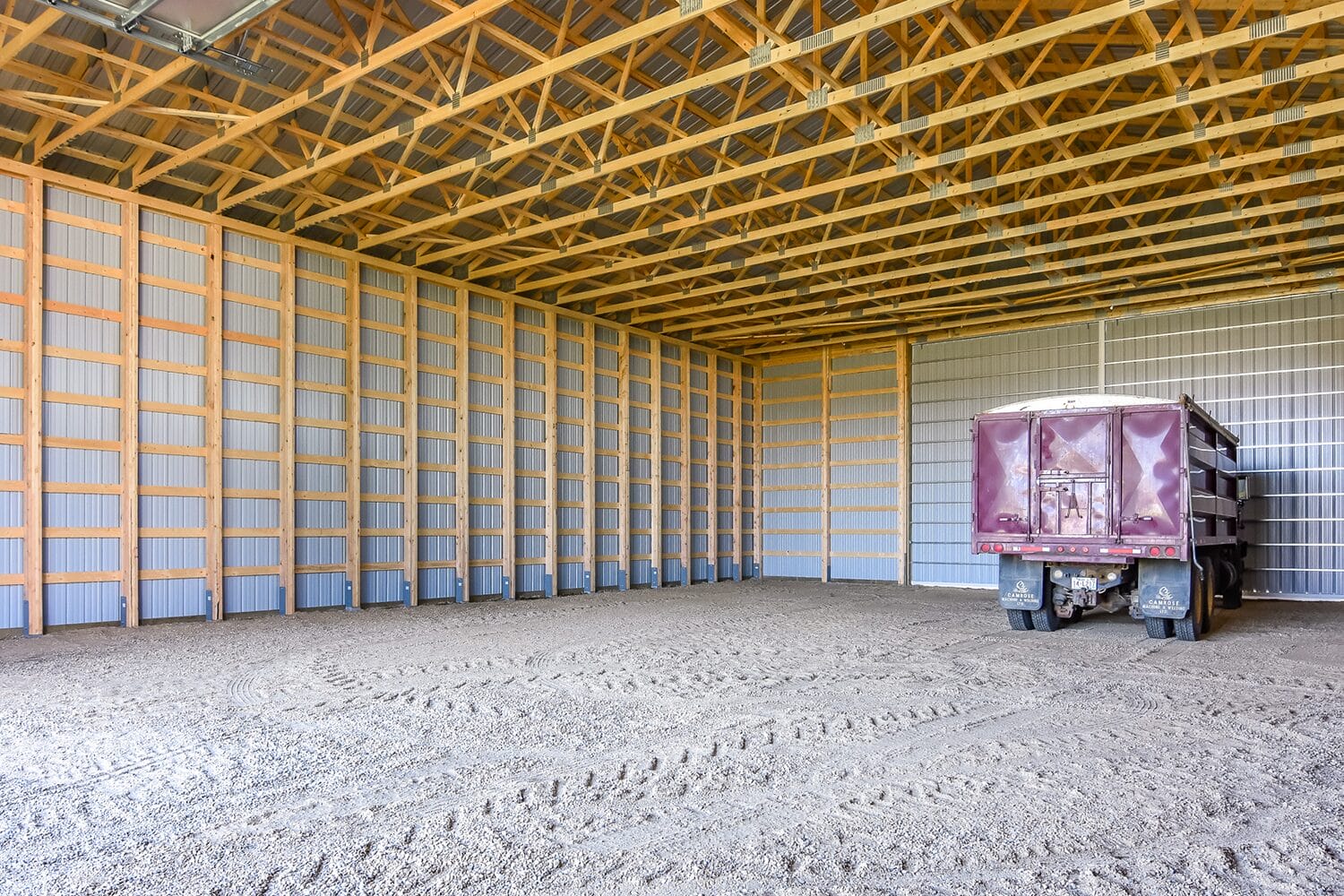
- The building solves more than your equipment storage problems. Putting a roof over your valuable machines is the largest, most measurable benefit of a machine shed, but they also benefit your operation by adding space to work through poor weather.
When farm equipment sits in the open, exposed to Western Canadian weather, the cost to your operation slowly adds up, and it’s rarely the maintenance bill you’ve budgeted for. It’s repairing the hydraulic line that wouldn’t have blown if it had spent the winter inside. It’s the time a machine spends in the shop instead of the field during harvest. It’s the trade-in value that’s lost by the time you’re standing on the dealer’s lot.
This is the case that machine shed builders make for cold storage: it protects you from most of that. The real question isn’t whether a machine shed saves money. It’s how much it saves you over time, and whether it’s worth building. This article walks through a research-backed approach to finding that answer
“The most expensive place to park a half-million-dollar combine is outside.”
What Outdoor Storage Actually Costs You
Rain, snow, hail, sun, and constant temperature swings are hard machinery. Left in the open, the elements work on the parts that are either expensive to fix or cost you time in the field—hydraulics, electronics, belts, seals, bearings, and tires. Paint fades, rubber dries and cracks, rust sets in, and sensitive components wear out sooner than they should.
The true cost of storing equipment outdoors shows up in three places, and only one of them hits your repair bill directly.
- Repairs you didn’t need to make: Moisture, freezing, and corrosion accelerate wear and make you spend more money on repairs than you need to. The real question becomes: how much of that is avoidable if machines are stored indoors?
- Lost days in the field: A machine that won’t start, or that breaks down at the worst time costs more than the repair itself. On a farm, time lost during seeding or harvest is a cost on its own.
- Faster depreciation and lower trade-in: A weathered machine looks used and has parts that look older than they are. Buyers and dealers place a premium on equipment that has been stored indoors, and without a machine shed, you miss out on that.
The important part when deciding whether or not to invest in a machine shed is calculating how much moving your equipment indoors could save you in real dollar values.
The Numbers: What Agricultural Research Says a Machine Shed Could Save You
The good news is you don’t have to guess at the savings. Researchers have measured the effects and done the math for you. An article published by Virginia Cooperative Extension looked at where farmers save by keeping equipment indoors—repair costs, downtime, and trade-in value—and then put a dollar figure behind each. Here’s what they found.
Repair Costs
Depending on the complexity of the equipment to be stored inside, it’s estimated farmers could save between 0.5–3.5% of the equipment’s value per year:
- Combines & Harvesters: 3.5% per year
- Tractors: 1.5% per year
- Planters & Seeders: 2.5% per year
- Tillage Implements: 0.5% per year
Downtime
Downtime savings are steadier across equipment types, but keeping a machine inside means it’s ready to run when you need it, which is estimated to save another 0.6–1.2% of its value each year:
- Combines & Harvesters: 1.2% per year
- Tractors: 1.2% per year
- Planters & Seeders: 1.2% per year
- Tillage Implements: 0.6% per year
Trade-In Value
Equipment that’s been kept under cover in a machine shed or other storage building holds its resale value better. At trade-in time, that’s worth an estimated 0.5–2.0% of the machine’s value per year:
- Combines & Harvesters: 2.0% per year
- Tractors: 1.6% per year
- Planters & Seeders: 1.2% per year
- Tillage Implements: 0.5% per year
Total Savings
When you add it all together, agricultural storage buildings that keep your machinery could represent significant savings for your farm every year. The following chart summarizes the information above and adds it all up to show the total percentage of your machine’s value you could save every year by moving it inside. It’s important to realize that not all of your savings show up as cash in hand. While a significant portion shows up as direct savings on repairs you’ll notice immediately, retained trade-in value only shows up years down the road. Both are real money, they just pay you at different times.
| Machine Type | Repair Savings | Downtime Savings | Trade-In Savings | Total Savings |
| Combines & Harvesters | 3.5% | 1.2% | 2.0% | 6.7% |
| Tractors | 1.5% | 1.2% | 1.6% | 4.3% |
| Planters & Seeders | 2.5% | 1.2% | 1.2% | 4.9% |
| Tillage Implements | 0.5% | 0.6% | 0.5% | 1.6% |
While these numbers come from a 2001 article, the underlying logic hasn’t changed—weather still takes a damaging toll on equipment kept outdoors. In fact, considering the complexity and high value of today’s equipment, the actual savings could be larger.
Calculating the Savings for Your Fleet
Where these percentages turn into a powerful decision-making tool is when you run them against your own fleet. To start, make a list of the equipment you plan to store inside a new machine shed, then multiply each machine’s value by its savings percentage to estimate how much you could save per year.
Here’s a simple example to outline the process. Say you’re planning to store three machines—one combine, one tractor, and one air seeder:
- A combine valued at $450,000 x 6.7% = $30,150 per year
- A 4WD tractor valued at $250,000 x 4.3% = $10,750 per year
- An air seeder valued at $200,000 x 4.9% = $9,800 per year
On just those three pieces of machinery, that’s roughly $50,700 saved in avoidable repairs, downtime, and trade-in value every year they’re stored inside instead of in the elements. Only a fraction of that shows up directly on your repair bills; you’ll appreciate the rest when harvest runs with fewer breakdowns or when it’s time to trade-in down the road. For operations with multiple tractors and combines, savings add up even faster.
To answer whether a machine shed is worth it for your operation, you’ll need to compare this number against what the building costs you.
Is a Machine Shed Worth It?
By now, you have one half of the answer: roughly what indoor storage saves you each year. The other half is what the building costs you. If you’re financing the building, you can compare yearly savings to your yearly payments. If you’re paying cash calculating the time it takes to pay back your investment works best.
If you’re paying cash take what the building costs and divide it by your yearly savings. Using the example fleet of one combine, one tractor, and one air seeder, that saves about $50,700 per year, here’s how that plays out for a few different buildings:
- A $200,000 machine shed pays for itself in about 4 years
- A $300,000 machine shed pays for itself in about 6 years
- A $400,000 machine shed pays for itself in about 8 years
For a post frame building that will stand for 50-60 years or longer, you spend a handful of seasons recovering the cost in the savings it creates, then they go straight into your pocket for the rest of the building’s life.
If you’re financing, compare your yearly savings to your yearly payments on the building loan. For a fleet built around high-value machines, the savings on avoidable repairs, downtime, and lost trade-in value often pay your yearly loan payment several times over. In effect, the building is paying for itself.
“A machine shed built for high value farm equipment typically can pay for itself in a matter of years.”
Which Equipment Benefits Most From Indoor Storage
As the savings numbers show, not every machine benefits the same amount. The research—and what we’ve seen across the buildings we put up—confirm one important thought: prioritize indoor storage for the machines with the most electronics, hydraulics, moving parts, and the highest price tags. Here’s the order that usually makes sense:
- Combines and harvesters
- Sprayers and applicators
- Seeders and planters
- Balers and forage equipment
- Tractors and trucks
- Grain carts
- Simple tillage implements
The machines toward the bottom of the list are where to compromise if space is tight. Simple tillage tools have fewer parts to damage and the least to lose to the weather, so they can sit outside while your combines and air seeders take priority.
Remuda Building designs and builds post frame machine sheds and equipment storage for farms across Alberta, British Columbia, and Saskatchewan around those priorities all the time. You can see those engineered storage buildings in our portfolio.
Common Questions About Machine Shed Benefits
For protecting your equipment by slowing rust, reducing weather damage, and holding trade-in value, an unheated cold storage building captures most of the benefits. A heated shop creates the comfort to service machines through winter and poor weather. The decision to build a machine shed or a heated shop depends on whether you plan to work in the building through winter or if you just need it for storage. Many farms build one structure that does both, dividing cold storage from a heated bay with a demising wall.
Yes. Sheltered machines show less fading, rust, and wear, and present as better cared-for—so dealers and buyers pay more. The research typically puts the trade-in gain alone at 1.6–2.0% of a machine’s value per year, before you count fewer repairs or less downtime.
It depends on the value of the equipment you store and what your building costs. But for a fleet built around high-value machines like combines and air seeders, the yearly savings often cover the building in just a few years—after which the savings keep coming for the decades the building stands.