KEY TAKEAWAYS
- Choosing the right post foundation decides how long a post frame building will perform safely, resist decay and protect your investment.
- The most serious risks to barns, workshops and hobby shops often start at ground level where wood, soil and moisture meet, so details like post protection and drainage need as much attention as trusses and metal cladding.
- Standard pressure-treated posts, Grade Guard sleeves and Perma Column foundations each offer different levels of protection, and the best option depends on soil conditions, moisture, building use and how many decades of service you expect.
- A foundation focused approach, where site conditions, footing design and post protection are prioritized ahead of finishes, reduces hidden repair costs, protects workflow and keeps the building functional for decades.
- Treating a durable foundation as a long term investment rather than an optional upgrade gives rural property owners peace of mind that their post frame building will stay straight, dry and reliable for the next generation.
Every great building stands on a decision made in conjunction with your post frame builder before a single wall goes up: the foundation. For post frame structures–whether a farm cold storage building, barn, a spacious workshop, or a cozy hobby shop–the foundation isn’t just concrete and wood in the ground. It’s the bedrock of your building’s longevity and long term value. If you’re investing in a new building, you want it to serve you reliably for decades, not become a headache of repairs after a few seasons. From the very start, your choices at the ground level determine how your building will perform against moisture, decay, frost, and the test of time. In fact, durability issues in construction can cost Canadians billions; building envelope failures alone rack up around $7.5 billion annually in repairs and replacements–a stark reminder that quality upfront saves costly fixes later. By prioritizing a “foundation first” mindset, you ensure your post frame project delivers the strength, efficiency, and peace of mind you expect. Let’s explore why the right post foundation choice aligns your building’s future with your budget from day one.
“A building is only as durable as the foundation it stands on.”
Why Your Foundation Choice Defines Your Building’s Future
A building is only as strong as the foundation it stands on. This isn’t just a saying; it’s physics and longevity in action. In post frame buildings, the vertical posts carry the entire load of your roof and structure down into the ground. If those posts and their footings aren’t up to the task, even the best-built walls and trusses can’t save the building from eventual failure. Your post foundation–how the wooden post are secured below grade–heavily influences how long they can resist rot and water damage. For example, many wood post foundations are treated to resist rot, but if they sit in poorly drained soil, the constant moisture can still cause damage over time. In the worst cases, structural wood can succumb to decay far sooner than expected, leading to costly structural repairs or even risk of collapse. The National Building Code of Canada and Canadian farm building standards recognize these risks, requiring minimum protective measures like pressure treatment (CSA O80 standards) for any post for houses or agricultural structures in ground contact.
Choosing a high-quality foundation system that matches your budget and longevity expectations sets the trajectory for your building’s lifespan. A well-protected post or a concrete foundation pier can give you 50+ years of service, whereas an untreated or improperly set post might fail in a fraction of that time. Industry experts consider it “premature failure” if a treated wood post shows decay in 12 to 15 years; they expect a properly protected post foundation to last 40 to 50 years or longer. The stakes are high: a foundation problem doesn’t stay hidden at the ground level; it affects your entire structure, causing doors to jam, roofs to sag, and expensive damages. By contrast, a robust foundation keeps your building solid and true so it can weather decades of use, heavy snow loads, and changing seasons without trouble. It’s telling that infrastructure experts estimate climate-related failures (including foundations damaged by flooding and thawing permafrost) could cost $300 billion in Canada over the next decade if we don’t build more resiliently. In short, investing in the right foundation means investing in the future resilience of your post frame building.
The Hidden Costs of a Poor Foundation Choice
Selecting budget-friendly foundations might save a little money up-front, but it can cost you in the long run. The hidden costs of a poor foundation choice often reveal themselves as unpleasant surprises down the road. One major cost is ongoing maintenance and repairs, and Canadian farm owners know this all too well. According to Statistics Canada, farmers spend over $1.35 billion each year on repairs and maintenance to farm buildings and fences, a portion of which is due to premature decay and structural fixes in pole barn posts and foundations. If your foundation posts start rotting or shifting, you might have to retrofit concrete piers, add splints to weakened columns, or even lift the entire building to replace failed posts. These procedures are complex and expensive, often requiring specialized contractors and significant downtime for your building’s use.
- Accelerated decay & repairs: A foundation that doesn’t protect against moisture invites rot and mould. Once decay sets into the wooden posts, repairs are unavoidable and costly – you might face excavating around posts or even dismantling parts of the building to swap out rotten sections.
- Operational downtime: Every repair is time your workshop can’t be used or your barn can’t shelter animals. If a foundation issue makes a barn unsafe, you’ll scramble to relocate livestock or equipment, impacting your productivity and peace of mind.
- Higher heating & maintenance costs: Poor foundations let in drafts and moisture. For heated workshops or livestock barns, that means higher heating bills and more effort to keep the interior dry. Damp conditions also corrode metal fasteners and create unhealthy environments for animals (think of hoof rot in cattle thriving in wet, mucky barn floors).
- Lost long term value: Buildings with foundation problems have lower resale or property value. Future buyers (or the next generation on your farm) see a ticking clock of repairs rather than a reliable structure. In contrast, a building that stands straight and solid 40 years later speaks to its enduring quality.
- Insurance & liability risks: Significant structural issues due to foundation failures might not be fully covered by insurance if they trace back to poor construction choices. You could also face liability if, say, a collapse causes livestock loss or other damages. Simply put, cutting corners at ground level can come back as financial and legal headaches later.
These hidden costs underscore a crucial point: what seems like a saving today could turn into exponential costs tomorrow. Investing a bit more in a durable post foundation system now–such as better rot protection or a concrete pier foundation upgrade–can save you from emergency repairs and rebuilds. It’s much like preventive medicine for your building. A solid foundation keeps the structure healthy, whereas a shaky one leads to chronic problems. The numbers don’t lie; Canadians collectively spend billions on building fixes that arguably could be prevented with better initial choices. By choosing the right foundation up front, you ensure your construction stays a reliable asset, not a recurring expense.
Which Post Foundation System is Right for Your Building?
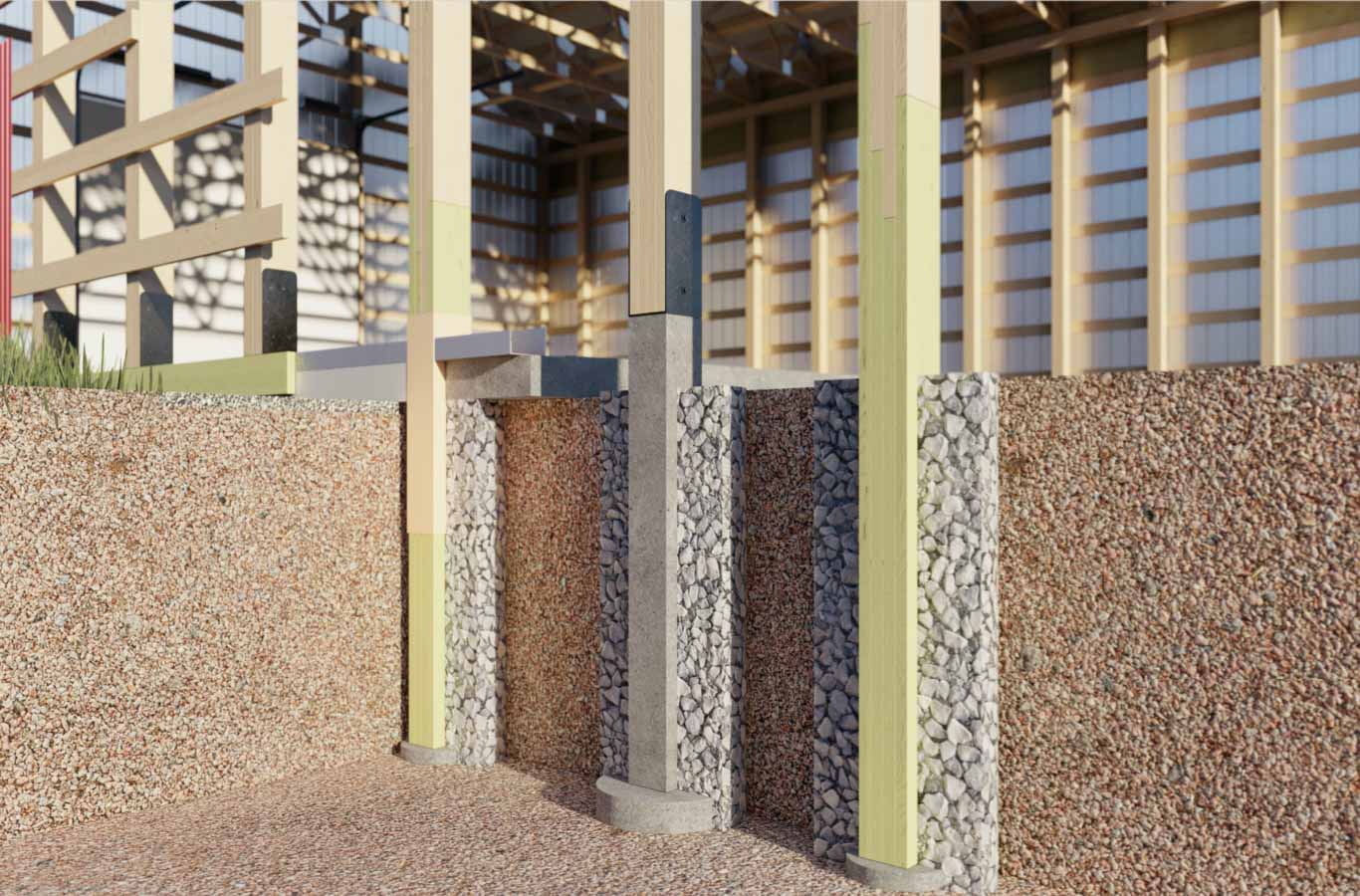
Modern pole barn builders offer a range of foundation options. Most popular options in Canada inlcude standard embedded pressure-treated posts, Grade Guard sleeves, and Perma-Column concrete piers, though other solutions like screw piles or steel columns are available. The best choice for your project depends on your goals, budget, and site conditions. Let’s break down these popular systems:
Standard Pressure-Treated Embedded Posts
The standard post foundation is the most basic approach. It uses pressure-treated laminated wood posts embedded directly in the ground. Remuda’s standard posts, for example, are built from 2″×8″ laminated pressure-treated columns for strength, set on a concrete footing at the bottom of the hole, and then backfilled with compacted crushed rock for drainage. The pressure treatment on the wood is critical–it guards against damage and rot from soil contact. Standard posts are cost-effective and quick to install, making them a popular choice for many agricultural and utility buildings.
With a standard embedded system, all ground-contact portions of the post are treated to high standards, protecting your building from decay caused by dirt and moisture. This means if you’re putting up a machine shed or post frame house on a budget, standard posts can perform well – especially in well-drained sites. However, their longevity depends on how well they were treated and installed. You’ll want to ensure proper uplift protection (so posts can’t heave or pull out of the ground in frost) and good drainage around each post. Standard posts give you solid durability and are engineered for the loads, but their Achilles’ heel is the ground contact itself. Over many years, the constant exposure to moisture and organics can begin to break down even treated wood. In moderate, dry soil conditions, a properly treated post can last for decades. But if your site has poor drainage or high water tables, you may consider upgrading to add more protection.
Grade Guard Post Protection
Grade Guard is an enhanced system that builds on the standard post by adding a protective sleeve around the most vulnerable part of the wood. A Grade Guard is a heavy-duty 30-inch polyurethane sleeve that slides over the lower portion of the post before it’s installed. It specifically covers from about 6″ above grade to 18″ below grade, which is the critical zone where moisture and oxygen most aggressively cause wood decay. By encapsulating the post in this zone, the Grade Guard keeps soil and water from directly contacting the wood. This prevents rot and extends the life of the post dramatically. Grade Guard gives an extra level of protection to prolong the lifespan of your building, without increasing cost or installation difficulty exponentially.
Buildings that use Grade Guard systems look the same above ground, but inside the post holes, those sleeves are silently doing the work of keeping your columns sound. This system is a smart middle-ground option if you’re concerned about decay but not ready to jump to an all-concrete solution. For example, if you’re building a horse barn or a hobby garage in an area that occasionally gets wet or has a lot of soil organics (which can accelerate wood rot), Grade Guard makes sense. By preventing post decay at the ground level, Grade Guard helps ensure your posts last effectively a lifetime under normal conditions. This means fewer worries about surprise repairs 15-20 years into the building’s life. The cost is higher than standard posts alone, but many building owners see it as worthwhile insurance in climates with a freeze-thaw cycle or any persistent moisture.
Perma-Column Concrete Foundations
For the ultimate in durability, Perma-Columns take the approach of keeping wood posts out of the ground. A Perma-Column is a 5-foot precast concrete column that replaces the lower portion of a wooden post entirely. In this system, you still have a wood post for the upper portion of the wall, but it is anchored on top of a concrete column that runs from the footing (below frost line) up to above grade. The wood never touches the soil–all ground contact is handled by concrete, which of course won’t rot. The wood-to-concrete connection is made with steel brackets and rebar anchors cast into the Perma-Column. Essentially, you get the cost-effectiveness and flexibility of post frame with the longevity of a concrete foundation.
Perma-Columns are ideal for permanent structures, heated buildings, or high-value uses. If you’re building something like an upscale workshop, a shop home, or a dairy barn where moisture is constant, you likely want the confidence that your foundation will never rot. The concrete columns are engineered for strength and can even be stronger in compression than wood. They also isolate the wood from ground-borne moisture and pests.
In Canadian climates, a big benefit is avoiding the gradual ground-line deterioration that even treated wood can face after decades–your building’s foundation will never rot with Perma-Column. These systems are typically more expensive up front for both materials and labour, but they pay off in essentially removing the foundation as a future failure point. For many, Perma-Column is the “premium” choice that provides maximum peace of mind, especially when you consider the total investment of a large structure.
Matching the Foundation to Your Needs
How do you decide among these options? Start with your building’s purpose and environment. Ask: Will the building floor be frequently wet (as in livestock housing or a wash bay)? Does your region have aggressive frost or termites? How long do you need this structure to last–is it a generational building for your family farm or a 30-year machine shed? If you’re constructing a post barn for sensitive livestock, keep in mind that animal comfort and health are directly tied to the building’s environment. A damp, shifting foundation can lead to uneven floors and moisture issues inside. This can contribute to higher ammonia levels and pathogen growth.
Cost is, of course, a factor. Standard post foundations will generally be the least expensive initially. Grade Guard adds a moderate cost but can be seen as adding decades of life–a high ROI when you consider that foundation failures lead to costly repairs in the future. Perma-Columns cost the most up front, but you’re essentially prepaying against any future rot issues. Think of a durable foundation as an investment: it can maintain the building’s value and save you from major rehab expenses down the line.
Finally, consider local soil and site uncertainty. If you have perfect, well-drained gravel soil and a small unheated shed, standard posts may be fine. But if there’s any question–wet soils, drainage challenges, high-value interior–err on the side of caution. Whichever system you choose, make sure it’s installed correctly and, if required, engineered to local code. A correctly installed standard post can outperform a poorly installed Perma-Column, so expertise matters. The good news is that modern post frame techniques are well-proven. From construction plans drawn up with engineered foundations to on-site soil prep, you have more control than ever over how your building meets the ground. Use that control to your advantage and tailor the foundation to fit your vision of long term success.
“Peace of mind is knowing that your building won’t surprise you with a sagging corner or a rotting post when the next heavy rain hits.”
A Durable Foundation is an Investment in Peace of Mind
When you invest in a new barn, workshop, or post frame building, you’re investing in your own productivity, comfort, and future. A durable foundation might not be the flashiest part of that investment–you don’t “see” it every day like you do the building’s exterior–but you feel its benefits every additional year your building goes without foundation issues. Peace of mind is knowing that your barn won’t surprise you with a sagging corner or a rotting pole when the next heavy rain hits. It’s walking into your workshop after a Canadian winter and finding the doors still square and the floor dry. You can’t put a price on that confidence, but you can put a value: it shows up in fewer repair bills and more usable days. In the agricultural world, peace of mind also comes from the well-being of your animals. Livestock housed in solid, dry facilities stay healthier and more productive–for instance, providing good footing and drainage can reduce hoof ailments, and maintaining a dry environment helps avoid respiratory issues. All of that starts with a foundation that keeps moisture out and stability in.
Think of a durable foundation as the gift that keeps on giving. Year after year, it quietly does its job, requiring virtually no attention if built right. This frees you to focus on your work or hobby, not on shoring up a settling building. Over decades, the financial logic becomes clear. The upfront cost of, say, upgrading to concrete columns might be a few thousand dollars, but if it prevents even one major structural repair, it has paid for itself. More so, it preserves the full value of your building. A well-founded structure remains an asset, whereas one with foundation issues can become a liability. In the big picture, choosing a durable foundation system is about aligning your spending with your values: if you value safety, longevity, and quality, then putting resources into the literal ground of the project yields the highest returns. In fact, preventive investments in durability can have tremendous payoffs; studies show that resilience measures can save multiple times their cost. On a smaller scale, your personal peace of mind is worth just as much.
Remuda Building has designed and built custom post frame buildings for farms, acreages, and rural properties across Alberta, British Columbia, and Saskatchewan since 2014. Explore our diverse range of projects in our portfolio.