KEY TAKEAWAYS
- Traditional methods can’t meet modern rural needs. Stick-built and steel structures are costly, rigid, and slow to construct, leaving rural property owners with fewer practical options.
- Post frame construction delivers lasting efficiency. Engineered posts eliminate the need for full concrete foundations, reducing materials and labour and enabling faster, year-round builds.
- Strength and flexibility come together. Post frame buildings combine structural integrity with clear-span interiors that adapt easily to a range of rural uses.
- Energy efficiency enhances long-term value. Deeper and wider insulation cavities, fewer thermal bridges, and wood framing make post frame buildings more comfortable and economical to heat and cool.
- Remuda is helping shape the future of rural construction. By combining craftsmanship, precision, and high-touch service, Remuda has helped make post frame the practical standard for modern rural properties.
Rural building priorities in Canada are shifting.
Not long ago, the focus for a new barn or farm shop might have been simply getting the lowest upfront cost or using whatever method was on hand. Today, farmers and acreage owners expect more. They want buildings that are durable, efficient to heat, adaptable in layout, and quick to put up–all without the overruns, delays, or compromises that often came with old construction methods. From barns and machine shops to modern country homes, rural Canadians are embracing an innovative approach that delivers on these needs.
Post frame construction is redefining how rural Canadians build–providing speed, efficiency, and structural strength for energy-efficient buildings that suit the land and lifestyle without the high costs or rigidity of traditional builds.
Rural Building Demands Have Outgrown Traditional Methods
Rural communities across Canada have seen significant change over the past few decades. Farms are fewer but much larger–Canada still counts roughly 190,000 farms, and the average farm size has nearly doubled in the last 50 years. This growth means modern farm operations have bigger equipment, more output, and broader infrastructure needs than the humble homesteads of the past. Outbuildings that sufficed a generation ago–like small wooden barns, basic steel quonsets, or makeshift storage buildings–often struggle to meet the demands of today’s farms and rural families.
Traditional construction methods in rural areas typically meant either stick-built wood framing, all-steel buildings, or small DIY pole barns. All three served their purpose, but rural property owners have begun to feel their limitations. For instance, a stick-built garage requires pouring an extensive concrete foundation. Not only does that drive up cost, but it also ties construction to warm seasons and involves long labour schedules for forming, pouring, and curing. Scheduling a traditional build can become a headache–a problem made worse by skilled labour shortages and material supply issues that have caused delays in projects across Canada. Farmers or acreage owners can’t afford to wait months on end or juggle multiple subcontractors during critical seasons.
Meanwhile, pre-fabricated steel buildings offer clear spans and can perform very well in certain applications, but many rural owners learn that they can be inefficient to heat and prone to condensation if insulation and ventilation are not carefully planned. In Canada’s climate, where space heating accounts for about 60% of the energy used in buildings, a basic, lightly insulated steel shed can feel cold, damp, and difficult to keep comfortable in winter. And while steel structures are strong, they often come as more generic designs that are not as easily personalized. Adding onto a steel building, partitioning interior spaces, or upgrading insulation after the fact can be difficult and costly. In short, traditional methods have often required rural property owners to compromise, accepting higher long-term operating costs, limited layouts, or seasonal delays as “just the way it is” for a barn or shop.
The reality is that rural building demands have simply outgrown these traditional methods. Farmers and acreage owners today aren’t just looking for a cheap shed; they’re often making a significant investment in a multi-use building–whether it’s a heated ag workshop, a large cold storage building, an indoor riding arena, or even a shop home. These projects require more flexibility, greater strength, better energy performance, and faster turnaround than old construction approaches were designed to deliver. It’s clear that rural Canada needed a better way to build. That’s where modern post frame construction comes in.
“Modern post frame construction is redefining how rural Canadians build—providing speed, efficiency, and structural strength for energy-efficient buildings that suit the land and lifestyle without the high costs or rigidity of traditional builds.”
Modern Post Frame Construction Answers Rural Challenges With Efficiency & Strength
Modern post frame construction has emerged as the answer to many of the challenges above by fundamentally rethinking how a building is supported and put together. A post frame building is built using large vertical wood posts buried or anchored deep in the ground, which serve as the primary structural supports. Instead of needing a poured concrete foundation along the entire perimeter, the posts themselves act as the foundation–transferring the weight of the roof and building directly into the ground. By using these engineered posts and an interlocking frame, post frame construction creates a very strong structure with far fewer materials and steps.
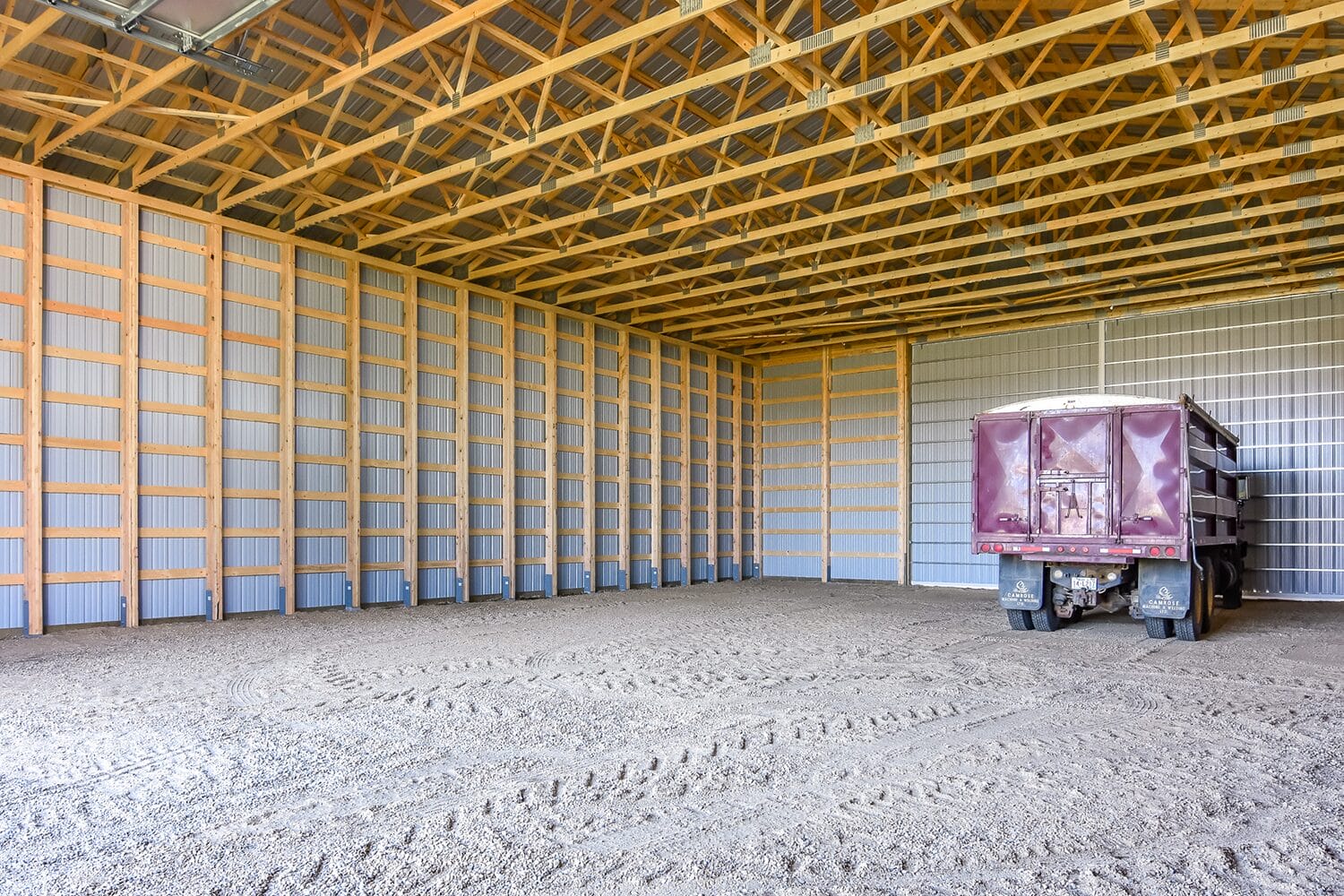
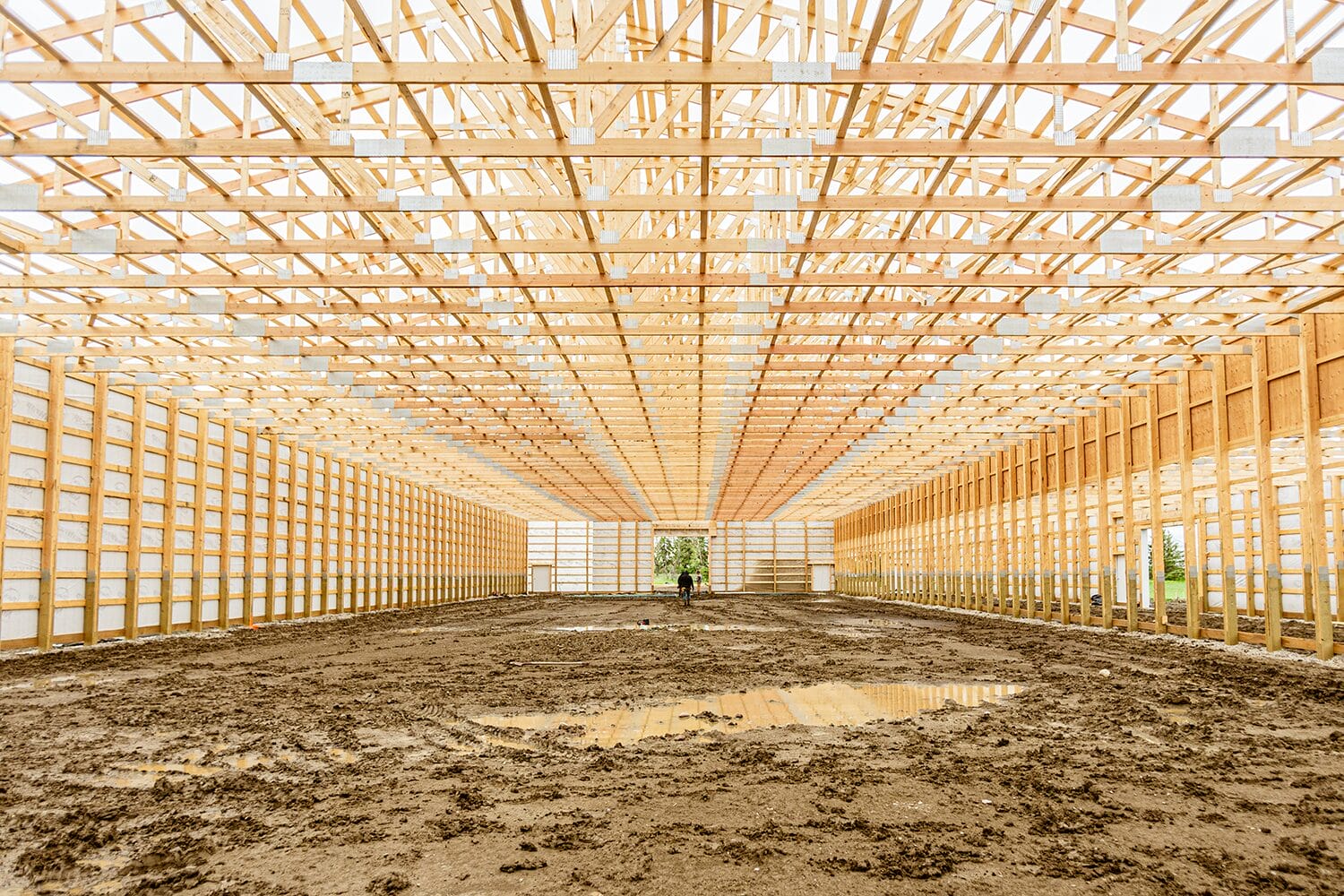
Importantly, this is not the same as pole barns of decades past. It’s an engineered building method that supports large footprints and clear spans while meeting or exceeding building codes. The posts are typically engineered laminated columns that are treated to resist rot or even set on concrete pier footings. They support prefabricated roof trusses spanning between them. Horizontal girts and purlins tie the posts and trusses together, and the exterior is finished with durable metal cladding screwed to the framing. The result is a robust skeleton that can stand up to heavy snow and wind loads–with no interior load-bearing walls needed. Each post-and-truss “pairing” bears the weight, creating a wide-open interior. In many ways, post frame combines the best of traditional pole buildings and modern engineering. It should not be confused with post-and-beam framing, which uses heavy timber beams and often intricate joinery. Post frame structures use engineered wood components and steel fasteners, making them much more efficient to construct than classic post-and-beam barns.
Crucially for rural property owners, post frame addresses efficiency and strength simultaneously. The simplicity of using posts in the ground means far less concrete and excavation work–often just small footing pads or collars for the posts–so a build can start quickly and even continue in colder months. Crews can drill post holes and set the posts in a matter of days, and immediately start on the roof structure. This method is incredibly efficient in terms of labour and time. Fewer framing members—posts are spaced several feet apart—rather than studs every 16″, also mean fewer pieces to handle overall. Yet the structure is not lightweight; those substantial posts and trusses create a structure that is built to last for decades. Modern post frame buildings in Canada are fully engineered to handle the local climate stresses, from Prairie blizzards to summer windstorms. In short, post frame construction is fast and material-efficient, solving the cost and timing headaches, and structurally strong, solving the durability concerns.
What does this look like in practice? Imagine building a detached garage with post frame. Instead of excavating and pouring a concrete foundation for weeks, you or your builder would auger holes and set deep wooden posts at set intervals. Those posts give instant structural support. Roof trusses are then mounted on the posts, and within days you have the outline of your building standing. There’s no lengthy wait for concrete to cure, and no costly forms or continuous footings. The efficiency is evident–fewer trades are needed, and there’s less downtime. At the same time, the strength is literally built into the system: each post embedded in the earth creates a stable point resisting wind uplift and lateral forces, much like a fence post set deep for stability. With the framing up, attaching pre-finished metal panels for the roof and walls is straightforward. The end result is a tight, strong structure erected in a fraction of the time of a comparable stick-built or steel-frame structure.
Post Frame Outperforms Stick-Built & Steel Buildings Where It Matters
Modern post frame isn’t just a little different from other methods–it truly outperforms traditional stick-built and steel structures in key areas. Here’s a breakdown of how post frame benefits stack up:
- Foundation & site preparation: Deep-set posts or concrete piers replace the need for a continuous concrete foundation, cutting costs and simplifying site prep. Stick-built and steel buildings rely on full slabs or footings that add weeks of labour and expense. With a post frame, you can build year-round—even through cold weather—because the posts serve as both frame and foundation.
- Construction speed & efficiency: Fewer framing and foundation components mean faster builds and less downtime. Once the posts and trusses are set, crews can enclose the shell quickly—often up to 50% faster than a traditional structure. This streamlined process also minimizes the number of trades needed and reduces costly scheduling gaps.
- Interior space & flexibility: Clear-span interiors remove the need for load-bearing walls, giving owners wide, open layouts. This design supports everything from farm equipment storage to riding arenas and barns to combined work-and-storage spaces. It also makes renovations more practical: adding partitions, mezzanines, large openings, or future extensions is straightforward because the structure is not dependent on interior supports. As needs evolve, the building can evolve with them.
- Insulation & energy efficiency: Walls can accommodate thick insulation with less heat conductivity than steel, improving comfort and lowering heating costs. Wood framing retains heat better, while the building envelope stays dry and tight. Insulated post frame buildings like acreage shops and garages often maintain temperature more efficiently through Canadian seasons.
- Structural strength & durability: Post frame construction combines engineered posts and trusses to handle heavy snow loads and high winds common across rural Canada. Unlike more rigid stick-built or steel structures, post frame buildings are designed with controlled flexibility, allowing the structure to absorb and shed environmental forces rather than fight them. This flex reduces long-term stress and potential failure points—delivering strength, resilience, and dependable performance for decades.
- Cost-effectiveness: Post frame construction generally requires fewer materials, shorter labour timelines, and no continuous foundation, making it more cost-efficient than many stick-built or steel-frame alternatives. These built-in efficiencies contribute to a strong overall value proposition for rural property owners.
In all these areas, post frame isn’t about minimizing quality or cutting corners. It’s about using intelligent engineering and efficient sequencing to deliver strength, speed, flexibility, and long-term value. For rural property owners comparing their building options, these performance advantages stand out clearly, making modern post frame a well-balanced and compelling choice.
Rural Property Owners Gain Flexibility, Speed, & Value With Post Frame
Ultimately, choosing a building method isn’t just about the materials–it’s about what you get out of the finished product. Modern post frame buildings shine in this respect by offering unmatched flexibility, rapid project completion, and long-term value.
Flexibility for Your Needs
Rural life and businesses are dynamic, and every property has its own workflow. Because post frame interiors are so open and the design is highly customizable, you can tailor the building to fit how you use your space right now. Need a layout that brings a machine workshop and cold storage under one roof? Or a garage sized and arranged to support hobby work, equipment storage, or a small office? Post and frame buildings allow those needs to be designed in from the start.
Clear-span interiors make it easy to place partitions, mezzanines, and large openings wherever they serve the workflow best. The structure supports practical layouts rather than dictating them. This flexibility also extends to aesthetics: while many buildings feature a clean, metal-clad exterior, they can be customized with porches, wainscoting, cupolas, or timber-style accents to match your preferred look, like this monitor-style shop. Some families choose post frame homes, such as barndominiums or country cabins, which leverage the open layout and warm character of wood framing paired with modern insulation and finishing.
The bottom line is simple: post frame gives you the ability to build a space that fits your lifestyle and work today, without being boxed in by structural limitations.
Speed and Convenience
Time is money in any construction project, but this is especially true on the farm or acreage where delays can disrupt your operations or seasonal plans. The speedy construction of post frame means you can go from planning to having a functional building on your property in a much shorter timeframe. For example, if you decide in late summer that you need a new heated workshop by winter, a post frame build stands a far better chance of making that deadline than a traditional build. The ability to build year-round is a huge plus–you can schedule the project even in the off-season. Faster construction also reduces the period that your property is a construction zone.
This convenience cannot be overstated: less downtime waiting for contractors, fewer weather interruptions, and earlier use of your new facility. Many rural property owners also appreciate that post frame construction is less complex to manage. Often, a single experienced post frame builder will handle the entire build from start to finish. You’re not having to coordinate separate framers, foundation crews, steel erectors, etc. This one-stop approach means a smoother process with fewer headaches. In short, post frame lets you get your building up and running quickly, so you can focus on your farm or business rather than on a prolonged build.
Long-Term Value
Perhaps most importantly, post frame delivers excellent value over the long run. Part of this is financial—the efficiencies in materials and labour often make the initial price of a post frame building lower than an equivalent stick-built or steel structure. But value isn’t only about what you pay upfront; it’s also about what the building saves or contributes over its lifespan. With an energy-efficient wall system, owners often see ongoing savings in heating and cooling when the building is insulated and used year-round. The durable, low-maintenance exterior reduces upkeep costs as well—the building continues to look good and perform reliably with minimal repair needs, even after years of sun, snow, and wind. Structurally, engineered posts and trusses offer long-term resilience, reducing the likelihood of costly structural fixes. All of this supports a strong overall return on investment.
Another aspect of value is how well the building serves its purpose. Because you can design a post frame structure around your exact requirements, it tends to deliver more functional use for every dollar spent. For example, a farm that invests in a post frame machine shed might also design in a heated workshop—effectively getting a multi-purpose facility more cost-effectively than building two separate structures. Or an acreage owner constructing a building might decide on a shop design with a guest suite, adding utility and potential resale appeal. These kinds of purpose-driven configurations are more difficult—and often more expensive—to achieve with other construction methods.
In this way, post structures add value to your property in a very practical sense. They can increase appeal if you decide to sell, since buyers appreciate a well-designed, fully usable outbuilding. And they enhance day-to-day productivity and quality of life on your land by giving you a space that works the way you need it to.
In summary, rural property owners stand to gain a great deal by choosing post frame construction. The flexibility means your building works for you, the speed means less hassle and quicker payoff, and the overall value means peace of mind that you’ve made a wise investment. The modern post frame isn’t just a construction method; it’s almost a philosophy of building smarter–doing more with less, and focusing on what actually benefits the end user.
“A building should reflect how you use your space, not force you to compromise because of outdated construction methods.”
A New Era of Rural Building is Being Shaped by Post Frame
All these factors come together to signal that we’ve entered a new era of rural construction in Canada—one where modern post frame techniques are playing a central role. The way barns, shops, and even homes are built in the countryside is undergoing a fundamental shift. It’s no longer about erecting the cheapest possible shelter and hoping it lasts; it’s about building for long-term performance and adaptability. Property owners today are thinking more like planners and investors than they once did. They consider energy efficiency, the productivity their building will support, long-term operating savings, and total cost of ownership—not just upfront cost. Post frame construction aligns well with these evolved priorities.
Culturally, this shift reflects a broader change. Agricultural operations have become more sophisticated, and their farm buildings must be built to keep up. Many young families are choosing acreage outbuildings with modern comforts. We’re seeing that traditional methods are being respectfully set aside in favour of innovative ones. You can drive through parts of Western Canada and notice the landscape dotted with new post frame structures–whether it’s a calving barn with sleeping quarters, a heated farm shop with a wash bay, or a stylish barndominium with a loft above the garage. These buildings stand out not because of extravagance, but because they function so well. They represent a mindset that quality and efficiency are worth the investment. In previous generations, a farmer might have built a pole barn as cheaply as possible, expecting it to be cold and dark but “good enough” for storage. Now, that same farmer might build a post frame workshop that is well-lit, fully insulated, and will serve his business for decades. The focus has shifted from purely minimizing cost to maximizing long-term value.
From a structural standpoint, the post frame is changing the game. Engineers and builders have refined the technique to the point where it’s a reliable solution for a wide range of building types. This has opened up possibilities that were once reserved for either heavy timber construction or expensive steel frames. Need an 80-foot-plus wide commercial building with no columns inside? Post frames can do that. Want a customized hobby shop that combines storage, work, and recreation under the same roof? Post frames can deliver it efficiently. The versatility of the method is encouraging people to re-imagine what a “barn” or rural building can be. It’s not just four walls and a roof–it can be a comfortable workspace, a venue, or a home, all achieved with the post frame approach.
Importantly, this new era isn’t just about the buildings themselves, but also about the building experience. The efficiency of post frames means projects can be planned and executed within a single year or season, without having to schedule multiple different specialized trades. Plus, costs are more predictable because there are fewer variables and delays.
All of these changes point to a structural and cultural shift: post frame is shaping a new normal in rural Canada, that of the modern pole building—efficient, strong, and purpose-built for how people actually use their space. This new era is defined by buildings that aren’t afterthoughts or necessary evils; they are investments that add real value. And as more rural property owners see the success of post frame projects in their communities, the momentum builds further.
Remuda Building has designed and built custom post frame buildings for farms, acreages, and rural properties across Alberta, British Columbia, and Saskatchewan since 2014. Explore our diverse range of projects in our portfolio.
Common Questions About Modern Post Frames
Post frame construction is a method of building that uses large vertical posts or columns for the primary support, instead of the many smaller studs and extensive foundation used in traditional stick-framing. These posts are typically set deep into the ground or anchored to concrete or steel piers and support roof trusses and the rest of the structure. In a traditional stick-built structure, you’ll have a concrete foundation, load-bearing walls, and hundreds of studs, joists, and rafters holding everything up. Post frame simplifies that by carrying the load with far fewer, but heavier, members. This means fewer pieces to assemble and no need for a full foundation. The result is a building that can go up faster and more efficiently. The most noticeable difference to an occupant is that a post frame building has a wide-open interior space thanks to those clear-span trusses, whereas a traditional build might have support walls or posts breaking up the space. In short, post frame construction yields a sturdy, open structure that’s efficient to build.
Yes – modern post frame buildings are engineered for strength and very much up to the task of handling Canadian winters. In fact, these structures often excel under heavy snow and wind loads. Each post frame building in Canada should be designed to meet the National Building Code requirements for the specific region, which include factors like ground snow load and wind speed ratings. The large wood posts in a post frame building are anchored deep, which helps resist wind uplift and even the ground shifting from frost. Roof trusses are engineered and spaced to carry heavy snow just as they would be in a house, but often spaced a bit further apart. Many farmers have found their post frame barns and shops to be just as durable, if not more so, than old stick-built barns. Longevity is also addressed by using treated wood for any posts in contact with the ground, preventing rot. Plus, features like roof ventilation and proper insulation, if heated, will prevent issues like condensation or undue snow buildup. Essentially, when built by professionals to code, a post frame building can last for decades in the Canadian climate – staying sturdy through blizzards, deep freezes, and thaws. Regular maintenance will ensure it stands the test of time. But rest assured, post frame construction is a proven method even in places like Alberta and Saskatchewan where winter is intense.
One of the key advantages of post frame construction is that you do not need a traditional concrete foundation under the entire building. The posts themselves act as the foundation by being embedded into the ground. This contrasts with stick-built structures that require continuous concrete footings or a basement. With a post frame, you save on extensive foundation work. That said, you can incorporate concrete in a post frame building in a couple of ways. Many people choose to pour a concrete floor slab inside their post frame building after construction – but this slab is non-structural, meaning it’s mainly for a clean floor surface, not for holding up the building. It can be poured after the building is up. Additionally, there are foundation upgrade options if you desire, such as Perma-Column concrete piers, which are precast concrete posts that your wooden posts sit on top of. But in general, a true post frame building doesn’t need a concrete foundation to stand strong – that’s a big part of what makes it cost-effective and quick to build. Deep-set posts are the foundation.
Absolutely! Post frame buildings can be insulated and heated efficiently, making them comfortable for workshops, garages, and even homes. In fact, post frame construction lends itself well to insulation because of the way the walls are structured. The posts are typically much larger than studs used in traditional framing (often 2″ × 8″ or larger, compared to 2″ × 6″ studs) and spaced several feet apart. This naturally creates wide, deep wall cavities that can accommodate thick batt insulation or spray foam to achieve high R-values. With fewer framing members interrupting the wall, there are also fewer thermal bridges — points where heat can escape.
Many post frame structures in Canada are finished as insulated shops or barns with R20, R30 walls or higher, plus insulated ceilings, and they often heat just as efficiently as comparable conventional buildings. The interior still needs to be finished with a vapour barrier and proper wall lining to hold the insulation in place, but once those components are installed, you have a well-insulated shell capable of excellent thermal performance.
Ventilation remains important to control moisture, just as it is in any insulated building. When insulation, vapour control, and ventilation are properly handled, a post frame building stays very comfortable in winter and cool in summer. Post frame building owners often report that heating costs remain reasonable relative to the size of the space. For example, an insulated post frame workshop with a unit heater or radiant system can maintain steady warmth thanks to the deep insulation cavities and the fact that wood framing doesn’t conduct heat the way steel can.
In summary, post frame buildings can absolutely be made energy efficient, and insulating them for year-round use is a common and well-proven practice in modern post frame design.
Post frame buildings are extremely versatile. They originated as farm barns and sheds, but today you’ll find them used for all kinds of purposes. Common applications include agricultural buildings, hobby workshops and garages, equestrian riding arenas and stables, commercial buildings, and homes. In fact, the term barndominium has become popular for homes that use post frame construction with living space integrated into the layout.
You can absolutely build a house with post frame construction. For residential projects, builders typically construct the full structural building — posts, trusses, roof, exterior cladding, doors, and windows — bringing it to a lock-up stage ready for interior finishing. For non-residential buildings such as shops, barns, and arenas, post frame structures are usually built out fully as complete buildings rather than delivered as partial shells.
Beyond homes, post frame construction is used for machine sheds, acreage workshops, airplane hangars, warehouses, equestrian buildings, and more. The key is working with an experienced post frame builder or engineer who can adapt the structure to the intended use and meet all applicable codes.
So yes, whether you need a home, a spacious workshop, or a sturdy barn, post frame construction can be tailored to your project. Its flexibility in size, layout, and function is a major reason it’s gaining traction across so many building types.